Showing posts with label Digital. Show all posts

Thursday, March 29, 2012

Index of Ports (Inputs and Outputs)

Video

Digital Video

HDMI (Can carry both audio and video)

DVI

Analog Video

VGA (High Resolution Analog)
S-Video/RCA (Yellow) (Low Resolution Analog)
Audio

Digital Audio (Provides Surround Sound)

Optical
Coaxial

Analog Audio

RCA (White and Red) Stereo

3.5mm (mini-jack) Stereo

Connect DVI Laptop to S-Video/RCA TV

Your Laptop (DVI Out)
Your TV (S-Video/RCA In)

While an extremely unorthodox setup, sometimes you have to work with what you have. In the instance of connecting your laptop's DVI OUTPUT to your TV's S-Video/RCA INPUT you'll need a few things. Before reading further though, I'd recommend using just about any other cable and conversion method available to you before doing this, as it requires more than 1 or 2 cables and a converter and to me just seems like more of a hassle than it's worth.


DVI to HDMI Cable

This cable allows you to send your digital signal from your laptop's DVI OUTPUT to your converter's HDMI INPUT in a single cable. 

HDMI to S-Video/RCA Converter

Once your DVI to HDMI cable is connected to your laptop's DVI OUTPUT, connect it to this converter's HDMI INPUT. Since DVI is unable to carry audio, this will only convert your laptop's video to an analog signal, meaning the only two cables that need to come out of this converter's OUTPUT are an S-Video cable (optional for better quality) and a single RCA video cable. There should be NO cables connected to the LEFT (white) and RIGHT (red) audio outputs, as there is no audio signal coming from them in this scenario.

RCA Video Cable

Connect one end of this RCA Video cable to your HDMI to S-Video/RCA converter's video OUTPUT and the other end to your TV's video INPUT.

S-Video Cable

For better video quality, connect one end of this S-Video cable to your HDMI to S-Video/RCA converter's video OUTPUT and the other end to your TV's S-Video INPUT.

Recommended Audio Connection


3.5mm to RCA Y-Splitter

There are many ways you can connect your audio to your TV, except in this convoluted solution the absolute easiest method is to get a simple 3.5mm to RCA stereo Y-Splitter. Connect the 3.5mm end to your laptop's headphone jack for audio OUTPUT, and the other end to your TV's left (white) and right (red) audio INPUTS. For more information regarding this cable, please read my article on connecting your laptop to TV via 3.5mm to RCA Y-Splitter.

Connect DVI Laptop to VGA TV and Vice Versa

Your Laptop (VGA Out)
Your TV (DVI-I In)

OR
Your Laptop (DVI Out)
Your TV (VGA In)


If you don't have a digital input available to you on your TV like HDMI or DVI, using a VGA input is the next best thing. While it doesn't carry a perfect signal like its digital cousins, VGA is capable of at least providing a higher resolution than any other non-digital cables. Known commonly as a "blue monitor cable," chances are if you're reading this on a desktop computer you probably have one within a few feet of you. VGA outputs are common on most laptops, but if you have a small netbook, DVI output may be your only option. If that's the case, you'll need this DVI to VGA converter cable. Just connect the DVI end into your laptop's DVI OUTPUT and connect the VGA end to your TV's VGA INPUT and you're all set.


Converting VGA to DVI

Unlike many of the other conversion processes on this site, converting a VGA signal to a DVI signal isn't always as straight-forward as you would think. This is due in part to the fact that there are several types of DVI ports and only a few of them will work with the cable listed above. The simple rule is this: If your TV's DVI INPUT has a small group of 4 pins off to the side this cable will work. If there is not a group of 4 pins, then it won't and you'll have to find a VGA analog to DVI digital converter like the one pictured to the left.
If your TV INPUT looks like a DVI-I connector, the cable will work.
If it looks like the DVI-D connector, you'll need a converter.

VGA to DVI and DVI to VGA Audio Options

Like every video cable, with the exception of HDMI, using the methods above will only get you half way in connecting your laptop to your TV. If you want your laptop's audio to play on your TV's speakers, you'll need to select one of the following options. While I recommend using an optical to optical cable or coaxial to coaxial cable if at all possible, if those options aren't available you can try one of the following.

Connect Laptop to TV via DVI

Your Laptop (DVI Output)
Your TV (DVI Input)

The simplest solution for connecting your laptop to your TV is to find a matching laptop output and TV input and get a single cable that connects the two. Currently, the only two ways to transmit a crystal clear digital video signal from most laptops to TVs is either with an HDMI or a DVI cable. If HDMI is not an option for you for one reason or another, DVI is your second best option.

DVI was developed in 1999 to transmit digital signals between two devices and its makeup is extremely closer to that of its newer cousin, the HDMI cable. The only main difference between the two is that DVI cables are unable to carry sound. With this cable, all you need to do is plug one end into your laptop's DVI OUTPUT and the other end into your TV's DVI INPUT and you're in business... For video anyway.

DVI Audio Options

Since DVI is incapable of carrying an audio signal on its own, you'll have to choose a separate option for transmitting sound from your laptop to your TV. My personal recommendations would be either optical to optical transmission or coaxial to coaxial transmission. However, if neither of those options are available, you'll have to pick a different one from the following list:

Connect HDMI Laptop to S-Video RCA TV

Your Laptop (HDMI Out)
Your TV (S-Video/RCA Out)


When dealing with newer laptops and older TVs, sometimes the only option is to take that excellent digital audio and video quality provided by your laptop and bastardize it down to an analog technology originally designed in the early 1940's. That's when you have to convert your laptop's HDMI output to your TV's S-Video or RCA input. Fortunately, it can be done for less than $50... Which is a lot cheaper than buying a new TV! Here's what you need to make it happen.


HDMI Cable

A simple HDMI cable will carry a digital signal from your laptop's HDMI OUPUT to your HDMI to RCA converter's HDMI INPUT port. 

HDMI to S-Video/RCA Converter

This device converts the digital HDMI signal from your laptop into an analog source that is output via S-Video and RCA cables. There are many models out there, but this one so far carries the best reviews and the most reasonable price.

To use it, plug the HDMI cable originating from your laptop into the adapter's HDMI INPUT end, and plug one end of your S-Video and RCA cables into the adapter's OUTPUT end.

S-Video Cable

While not entirely necessary for the HDMI to RCA conversion to work properly, the use of an S-Video cable will improve your video quality. It won't be mind-blowing by any stretch of the imagination, but it will make your image crisper and text easier to read.

One end of the S-Video cable will plug into your adapter's S-Video OUTPUT and the other end will plug into your TV's S-Video INPUT port.

Component (RCA) Cable

The old tried-and-true, 3-color RCA cable is still probably the most common A/V connector cable available. Each of the three cables are physically identical, but are color coded for ease of use. Traditionally, the yellow cable carries video, red carries right-channel audio, and white carries left-channel or mono audio.

As with the S-Video cable, one end of each of the three cables will plug into the adapter's Video, Left, and Right OUTPUT while their corresponding ends will plug into your TV's Video, Left, and right INPUT port. 


HDMI to S-Video/RCA Audio Options

If you are able to transmit audio through your HDMI cable, there's nothing else you need to do. The converter takes care of the audio and you're in business. However, if your video card is unable to transmit audio over your HDMI cable, there are a few other common options for you to connect your laptop's audio to your TV's speakers.

Connect HDMI Laptop to VGA TV

Your Laptop (HDMI Out)
Your TV (VGA In)
If connecting your laptop to your TV directly with an HDMI cable or with an HDMI to DVI converter cable isn't an option, the next best option is to use an HDMI to VGA converter. While VGA is not a digital signal like HDMI or DVI, and therefore will never be quite as crystal clear, it does allow for higher resolutions than its component, S-Video, and RCA counterparts.

Using an  HDMI to VGA converter to connect your laptop to your TV will allow for 1920x1080 resolutions (the same pixel resolution as 1080p), but when viewing the same picture at the same resolution through an HDMI cable, the trained eye will notice a slight difference in quality. In order to successfully connect your laptop's HDMI output to your TV's VGA input, you'll need the following items.


HDMI cable

First, you'll need a standard HDMI cable. Nothing fancy is necessary; a simple, $3-$5 cable with good reviews is all you need. Don't get tricked by a salesman at Best Buy into buying a $200 "guaranteed for life" Monster cable that carries the exact same 1's and 0's as a $5 BlueRigger cable.

One end of this HDMI cable will attach to your laptop's HDMI OUTPUT and the other end will attach to your HDMI to VGA converter's HDMI INPUT.

HDMI to VGA Converter

Since HDMI carries a digital signal and VGA carries an analog signal, a converter is necessary to connect your HDMI laptop to your VGA TV. In addition to converting video, this adapter also will take audio from your HDMI cable if you so desire and output it to an analog 3.5mm audio format.

To use this adapter, simply plug the HDMI cable originating from your laptop into the adapter's HDMI INPUT port and plug one end of your VGA cable into the adapter's VGA OUTPUT slot.

VGA cable

Lastly, you'll need a VGA cable to carry the analog signal from the adapter to your TV. A VGA cable is your basic monitor cable and usually has a blue colored plug on each end. If you have a spare montior cable lying around (make sure it's VGA and not DVI) that will work as well.

One end of your VGA cable should already be plugged into your adapter's VGA OUTPUT port, so simply plug the other end into your TV's VGA INPUT port, change your TV's input to VGA, and you should be up and running!

HDMI to VGA Audio Options


While HDMI cables have the ability to carry audio, VGA cables, being analog in nature, do not. There are several options you can pursue when connecting your laptop's audio to your TV's speakers. However, considering the build of the HDMI to VGA converter listed above, your best bet in my opinion is to simply buy a 3.5mm analog audio cable and connect it from your converter directly to your TV. Check to make sure your TV accepts 3.5mm audio input first, but chances are if it accepts VGA video input it does. Then, set your computer to send audio over HDMI and you're in business!

Wednesday, March 28, 2012

Connect RCA Laptop to Optical or Coaxial TV Audio

Your Laptop (Composite (RCA) Out - Very Unlikely)


Your TV (Optical In)
OR
Your TV (Coaxial In)

Considering this is so rare, I'm not sure why I'm even posting it, but I figured since it's a possibility I might as well list it if someone is really desperate. I recommend this method as an absolute last resort. Using this converter will not up-scale your analog stereo output (via RCA) to a clearer digital version through optical or coaxial, so this method really just seems silly. That being said, if your laptop has a composite (RCA) output you can connect it to your TV through an optical or coaxial input using the following items.


Composite (RCA) Cable

The RCA cable will carry an analog signal from your laptop to the analog-to-digital converter before getting to your TV. To use this cable, plug one end into the red and white RCA OUTPUT ports on your laptop and the other end into the red and white RCA INPUT ports on the analog-to-digital converter.

RCA to Coaxial/Optical Audio Converter

This device converts an analog RCA signal originating from your laptop and converts it to a digital coaxial or optical signal for use on your TV. Make sure the RCA cables coming from your laptop are plugged into the converter's INPUT and the coaxial or optical cables are plugged into the converter's OUTPUT.

Coaxial Cable

The coaxial cable carries a digital signal from the analog-to-digital converter to your TV. Make sure one end of your coaxial cable is plugged into the OUTPUT of your analog-to-digital converter and the other end is plugged into your TV's coaxial INPUT.
OR

Optical (Toslink) Cable

If you don't wish to use a coaxial cable with this device to connect your laptop to your TV you may elect to use an optical cable instead. The optical cable carries a digital signal from the analog-to-digital converter to your TV. Make sure one end of your optical cable is plugged into the OUTPUT of your analog-to-digital converter and the other end is plugged into your TV's optical INPUT.

Connect Laptop to TV Audio via Coaxial Cable

Your Laptop (Coaxial Out)

Your TV (Coaxial In)


Before optical and HDMI cables were as prevalent as they are today, the only way you could get a fully digital surround sound experience was to use a digital coaxial cable. While virtually identical to other RCA cables, digital coaxial cables carry a strong signal of 1's and 0's from the source (laptop) to the receiver (TV), allowing for true Dolby Digital surround sound to be experienced in the comfort of one's home. While the coaxial cable doesn't win many points for style, unlike its cousins the light-based optical cable or the all-in-one audio/video HDMI cable, it gets the job done just the same. Use this cable to get crystal clear digital sound when connecting your laptop to your TV.

Connect Optical or Coaxial Laptop to 3.5mm or RCA TV Audio

Your Laptop (Optical Out)
OR

Your Laptop (Coaxial Out)


Your TV (3.5mm In AKA "Aux In")

OR

Your TV (Composite (RCA) In)

While not the most ideal solution, sometimes you don't get to choose what ports you have to work with. In the event you have an optical or coaxial output on your laptop and a 3.5mm input or a composite (RCA) input on your TV, you'll need three of the following five items to successfully connect your laptop audio to your TV's speakers.


Optical (Toslink) Cable

The optical cable carries a digital signal from your computer to the adapter, where it gets converted to an analog signal. One end of the optical cable will go into your computer's OUTPUT and the other end will go into the digital-to-analog adapter's INPUT.

OR


Coaxial Cable

The coaxial cable carries a digital signal from your computer to the adapter, where it gets converted to an analog signal. One end of the coaxial cable will go into your computer's OUTPUT and the other end will go into the digital-to-analog adapter's INPUT.


Digital (Optical/Coaxial) to Analog (3.5mm/RCA) Converter

A digital to analog converter is required to convert the optical or coaxial cable's digital signal to that of an analog signal that may be utilized by a 3.5mm cable or two Composite (RCA) cables. This particular adapter only works one way. This means the optical or coaxial cable must leave your laptop's OUTPUT port to plug into the adapter's INPUT side, and the 3.5mm or RCA cable must leave the adapter's OUTPUT and plug into your TV's INPUT port.


3.5mm (Mini-jack) Cable

One of the most universal stereo audio cables available, the 3.5mm cable can be applied to just about everything. iPods, smart phones, laptops, and TVs are just a few devices that have the ability to utilize a 3.5mm cable in some fashion. This cable will plug into the adapter's OUTPUT port, with the other end plugging into the TV's INPUT port.

OR


Composite (RCA) Cable

Alternatively, if your TV doesn't have a 3.5mm input, chances are it has a composite input. This cable requires two ends for stereo or one for mono. For mono sound, plug one end of the white-tipped cable into the digital/analog converter's OUTPUT port and the other end into your TV's INPUT port. For stereo, do the same with the red-tipped cable. Once all the cables are properly connected to your laptop and TV through the adapter, your sound should come through perfectly!

Connect Optical Laptop to Coaxial TV Audio and Vice Versa

Your Laptop (Optical Out)
Your TV (Coaxial In)
(OR THE OTHER WAY AROUND!)

When connecting your laptop to your TV you want to try your hardest to maintain a digital signal. This allows for crystal clear audio and is the only type of signal that allows for full surround sound. However, sometimes you'll run into issues where your Laptop outputs don't necessarily match up with your TV inputs. If your laptop has an optical output and your TV has a coaxial input, you'll need these three things in order to maintain that clear digital signal.


Digital Coaxial Cable

A digital coaxial cable is required to connect your digital/analog adapter to your TV's coaxial input. While this particular cable is designed specifically for this purpose, if you have any spare RCA cables (regardless of their color) lying around, those will work too.


Optical (Toslink) Cable

An optical (Toslink) cable is required to connect your laptop or desktop's optical output to a digital/analog adapter box.


Dual Output Digital Audio Adapter

While the signal passing through each cable is ultimately sent and received in a digital format, the medium through which it is passed is significantly different. An optical cable passes the digital signal by rapidly flashing a red light from the laptop to the TV. A coaxial cable, on the other hand, uses electric pulses to transmit the digital signal. Since it would be impossible to convert light into electricity by using a simple cable, a digital audio adapter is required.

This adapter is one of the few that will allow you to convert an optical signal to a digital coaxial one and convert the other way around. This adapter, combined with the two cables listed here will successfully connect your laptop's audio to your TV. Simply plug one end of the proper cord into your laptop's audio OUTPUT and plug the other end into the adapter's INPUT side. Then, plug one end of the second cable into the adapter's OUTPUT side and the other end into your TV's INPUT. Then you're all set!


Connect Laptop to TV Audio via Optical (Toslink)

Your Laptop (Optical Output)

Your TV (Optical Input)

To experience the highest quality audio while transmitting video from your laptop to your TV, you'll need an entirely digital signal. Digital signals send over 1's and 0's from a source to a receiver. Analog signals are sent over in waves. Think of it as a light switch vs an old radio dial. The light switch can either be on or off, while the radio dial can be tweaked in any direction to produce a slightly different result. With digital audio cables, the sound either comes through at crystal clear, 100% quality or it doesn't work at all. Digital audio cables are also the only cables that can carry proper surround sound signals.

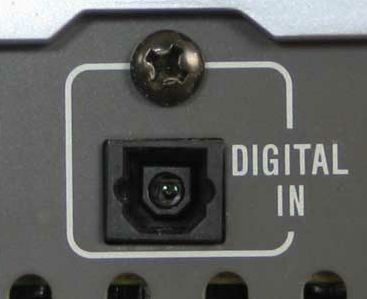
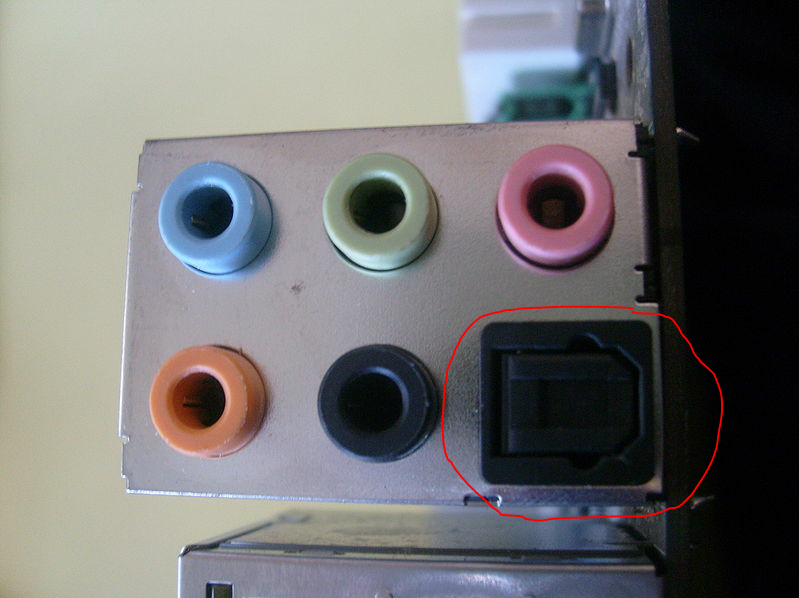
There are several ways to transmit a digital signal from your laptop to your TV. One of the earliest, designed in 1983 by Toshiba and still in use today, is the optical (Toslink) audio cable. This cable takes a beam of red light from the source and transmits it via fiber to the receiver. If you have an optical output on your laptop or desktop and an optical input on your TV (seen above), this cable is the only thing you need.

Due to the physical design of these cables they tend to be slightly rigid and sometimes difficult to maneuver. For that reason I recommend getting a cable slightly longer than you would otherwise think you'd need. If you are connecting your laptop to your TV from 5 feet away, I'd recommend going with at least a 10 foot cable instead of 6. That being said, you'll get the same crystal clear signal using an optical cable as you would over HDMI, so if this option is available to you I highly recommend it.

Tuesday, March 27, 2012

Connect Laptop to TV via HDMI

Back in the day it was an accepted fact that in order to transfer audio and video from one source to another they needed to be transferred over at least two separate cables. Anyone who has ever bought a VCR is likely more than familiar with these old-school RCA cables.

With these cables, the yellow cable carried the video data, the white cable carried left-channel (or mono) audio, and the right cable carried right-channel audio. If you had all three outputs on your VCR but your TV only had the yellow and white inputs you were getting mono sound whether you liked it or not. Flash forward to 2003 and suddenly we were able to get pure digital video and surround sound over a single cable. Behold the magic of the High-Definition Multimedia Interface (HDMI) cable!

HDMI Cable via Wikipedia

If your laptop and TV both have an input in this shape, chances are this little cable is all you need. To determine whether or not that's the case, check both your TV (or receiver) and laptop for an HDMI port. It may say HDMI or BD (short for Blu-Ray Disc), or any number of other various inputs. However, if it looks like this with the two tapered corners, it's an HDMI port.

HDMI input via Wikipedia

Connecting Your Laptop to Your TV

You'll want to find an HDMI output port on your computer and an HDMI input port on your TV or receiver. Since most computers and laptops do not possess an HDMI input, we can assume any HDMI slot found on your computer is HDMI output. First, make sure your laptop is booted up and your TV is turned on. Next, using your HDMI cable, connect the HDMI output on your laptop to the HDMI input on your TV. Take note of the exact name of the HDMI input you're plugging into on your TV (e.g. HDMI-1, HDMI-2, BD, SAT, etc...)

If you're really lucky, your TV will automatically change its input to the newly detected source and you'll instantly see a duplicated version of your desktop appear on the TV. If you're even luckier, the sound card on your laptop will automatically detect the change and will route all audio directly to the TV. However, if there's one thing I've learned over the years of dealing with IT and A/V equipment, it's that no one is ever that lucky.

If your TV did not automatically switch to the new input source, grab your TV's remote and press the button labeled Input or Source or TV/Video. It may be named something else, but those are the three most common button names I'm aware of. Keep pressing this button while you see the different inputs cycle through on your TV screen. Stop pressing it once you see the input on your TV screen match the input you plugged the HDMI cable into (HDMI-1, HDMI-2, BD, SAT, etc...) Now your TV is set to the proper input.

If you are still having issues with the video or audio not appearing as it should on your TV, please see my article on how to configure your laptop to connect to your TV.

Shopping for an HDMI Cable


Cables, accessories, and other various peripherals have long been the providers of the highest margins at retail electronic stores like Best Buy (trust me, I used to work at Circuit City). They'll try (and often succeed) in selling you the "top of the line, gold plated, guaranteed for life" cables for any electronic device you may purchase. One of my friends, without consulting me first, got suckered into buying a Monster brand, gold-plated, 10-foot HDMI cable for $120. The sales rep told him that it was the highest quality HDMI cable available and that it carried the best possible quality video and audio that was on the market. He said it was gold plated so it would never oxidize like some of the other "cheaper cables" and that if anything ever went wrong with it, he was guaranteed a replacement for life.


What the sales rep failed to mention to my friend was that HDMI carries a digital signal (that's literally 1's and 0's), so any quality signal is always going to be the highest possible quality. With digital signals the picture and audio either work... or they don't. There is no in between.

So, don't do what my friend did. When buying an HDMI cable to connect your laptop to your TV, buy in bulk and buy cheap. A simple, 2-meter HDMI cable that carries every signal you could possibly need only costs a few bucks on Amazon Prime... And for the price of 1 Monster cable from Best Buy you could buy 20 of these.